
Articles8 min read
Open-ended vs closed-ended questions: when to use each
Closed-ended questions give respondents a fixed set of answers and give you numbers; open-ended questions let people answer in their own words and give you reasons. Neither is “better” — they answer different questions about your customers, and the strongest feedback setups deliberately pair one with the other. Here’s when to use each, with examples.
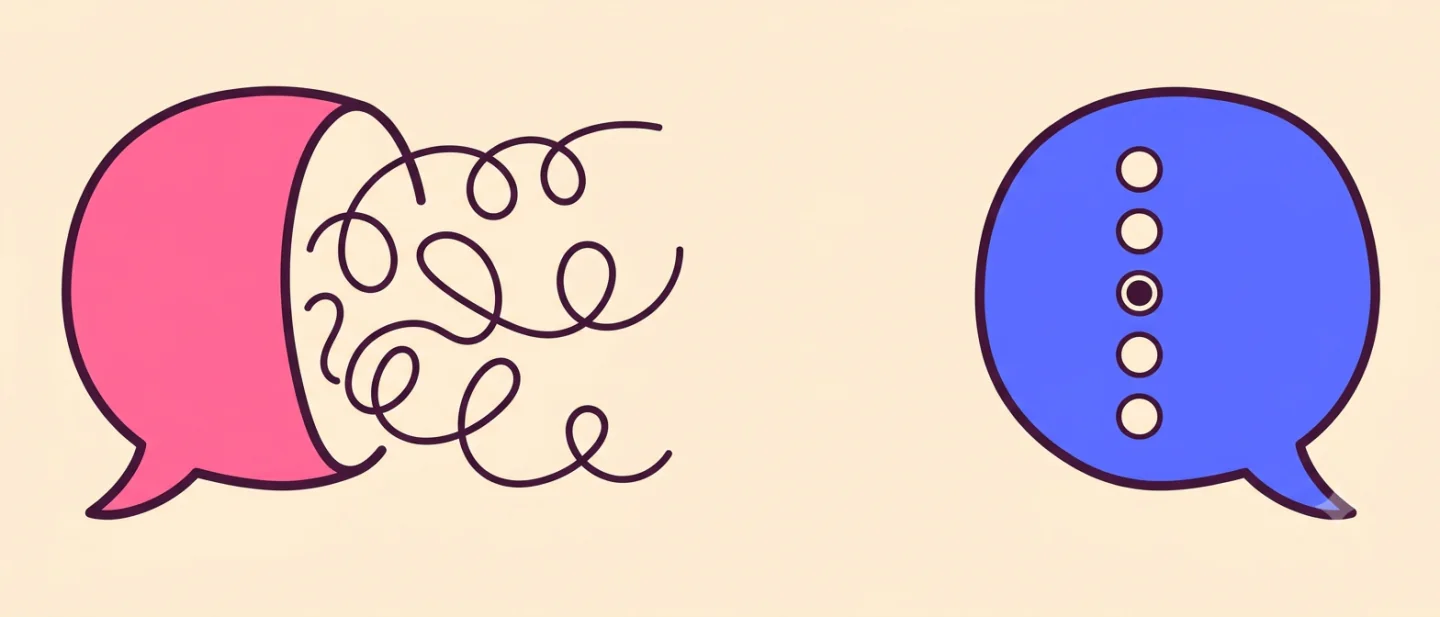
Closed-ended questions: measurement
A closed-ended question constrains the answer: yes or no, one of five options, a number on a scale. That constraint is the feature — every answer is comparable with every other, so you can count, track over time, and split by segment.
Closed-ended examples
- “Was this page helpful? (yes / no)”
- “How easy was setup? (1–5)”
- “Which best describes your role? (founder / PM / engineer / other)”
- “How likely are you to recommend us? (0–10)”
Strengths
- Effortless to answer — a tap — so participation is high.
- Instantly quantifiable: trends, comparisons, dashboards.
- Consistent across respondents and across time.
Limits
- You only learn about the options you thought to offer. The answer that would surprise you isn’t on the list.
- A score contains no explanation — a 2/5 tells you something is wrong and nothing about what.
- Poorly chosen options actively mislead: forced choices, overlapping ranges, and “other” catching a third of responses.
Open-ended questions: explanation
An open-ended question hands the respondent a blank space. The answers are messier and rarer — writing costs more than tapping — but they contain the things you didn’t know to ask about: the vocabulary customers actually use, the workaround they built, the competitor you hadn’t heard of.
Open-ended examples
- “What almost stopped you from signing up today?”
- “Walk me through the last time you used this feature.”
- “What were you expecting to happen instead?”
- “If you could change one thing, what — and why that one?”
Strengths
- Surfaces the unexpected — problems and ideas outside your option list.
- Captures reasons, context, and emotion in the customer’s own words.
- Great verbatims travel: one vivid quote moves a roadmap meeting more than a chart.
Limits
- Higher effort, so fewer people answer — and the ones who do skew toward the opinionated.
- First answers are often vague (“it’s confusing”) and need a follow-up to become specific.
- Free text must be read and coded into themes before it can inform a decision.
When to use which
| Situation | Use |
|---|---|
| Tracking satisfaction over time | Closed (same scale, every time) |
| Understanding why a metric dropped | Open |
| You know the 4–5 likely answers and want counts | Closed |
| Early discovery — you don't know the answers yet | Open |
| Deciding between two known options | Closed, with an open 'why?' |
| Exit / churn feedback | Open (a dropdown hides the real reason) |
The classic mistake
Writing a multiple-choice question before you’ve heard real customers describe the problem. The options end up encoding your assumptions, respondents obligingly pick one, and the chart confirms what you already believed. Run the open version first, with even a dozen people; write the closed version from their words, not yours.
The pattern that gets you both: rate, then ask
The highest-performing feedback flows open with a closed question and follow with an open one. The tap gets participation — far more people will rate than write — and the follow-up, asked about the rating they just gave, gets the reason while it’s live: “You gave that a 2 — what went wrong?”
This is exactly how Feedback Mango structures a study: an optional one-tap rating opens the door, and the AI interviewer follows up conversationally, asking the next question based on the previous answer. The result is closed-question response volume with open-question depth — see conversational surveys for why the chat format itself lifts answer quality.
Frequently asked questions
- What is the difference between open-ended and closed-ended questions?
- A closed-ended question offers a fixed set of answers — yes/no, multiple choice, or a rating scale — and produces numbers you can count. An open-ended question lets the respondent answer in their own words and produces text you have to interpret. Closed questions measure; open questions explain.
- When should you use open-ended questions in a survey?
- Use open-ended questions when the reason is the point: understanding why a score is low, what almost stopped a purchase, or what a customer expected. They are also essential early on, before you know enough to write good answer options — a multiple-choice list written from guesses just measures your guesses.
- What is an example of an open-ended survey question?
- Examples: 'What almost stopped you from signing up today?', 'Walk me through the last time you used this feature', and 'If you could change one thing about the product, what would it be — and why that?' Each invites a story rather than a verdict.
- Can a survey have both open-ended and closed-ended questions?
- Yes — the strongest pattern pairs them: a closed question for participation and counting (a rating or thumbs), followed by one open question about the answer just given. The score tells you where to look; the words tell you what to do.
Try it on your site
Let a tiny AI interviewer ask the why
Feedback Mango puts a small AI interviewer on your website: you write one question, it has a short chat with every customer who answers, and the conversations arrive sorted into topics and next steps. Setup is one line of code, and it’s free while in beta — no card.